“Four years. Four Webbys. Every one of them in AI. We set out to build an AI product the market hadn't seen — Elva, a video director that runs on voice, not menus. Taking home our fourth People's Voice Webby in four consecutive years confirms what we've believed since the first AI brief: good UI is what makes AI usable, and we are now — officially and repeatedly — the agency that builds it.”
{{Kirill Lazarev}}
We won the Webby for best visual UI in AI — for the 4th year in a row
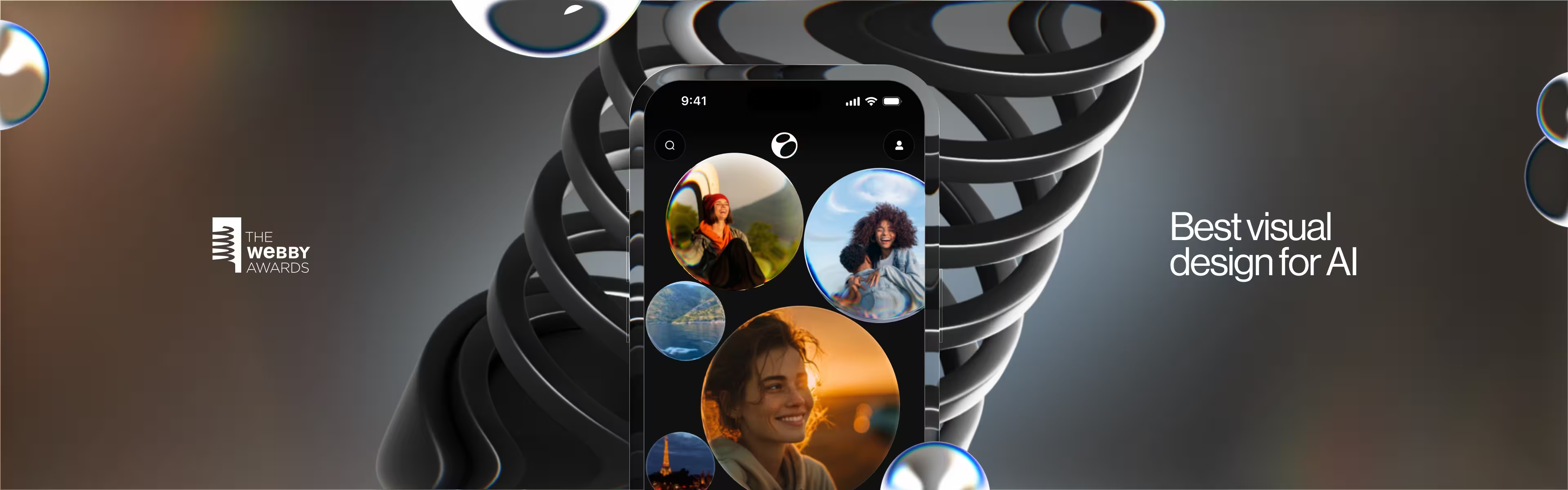
Lazarev.agency has won the 30th Annual Webby People's Voice Award in the Visual Design AI category — with Elva, the voice-first AI video director we designed end to end.
That makes four Webbys in four consecutive years, every one of them for AI product design. Four years running, the same jury and the same global public vote have named our work #1 in the AI category they care about most — the one Google, Apple, Netflix, Spotify, and every serious consumer-AI team in the world enters their best work into.
Which means, very specifically, this: we are officially — and repeatedly — the agency that designs the best UI for AI.
For a digital product design agency that has built its practice around AI product design — AI UX, AI UI, AI brand, AI persona, and agentic interaction models — winning Best Visual UI in the AI category at the Webbys four years in a row is the proof stack the market was asking for. Not a trophy on a wall. A record.
What the Webby is — and why winning it four times in AI matters
The Webby is the internet's highest honor. Since 1996, it has recognized excellence across every surface of the internet — websites, apps, advertising, film and video, social, podcasts, games, and now AI. It is the award Google, Apple, Netflix, The New York Times, Spotify, Adobe, and every major consumer-technology company submits their best work for, every single year. To be nominated is a shortlist event in itself. To take home the People's Voice Webby is a public vote of confidence from millions of users around the world — not a closed panel of industry judges.
To take it home four years in a row, in the AI category, against that field, is something else entirely. It means a pattern. It means a category. It means the people who decide the internet's best work have already decided where the best UI for AI gets built — and they keep deciding the same way.
Winning in the AI Features & Innovation track — specifically in Visual Design AI — is a different kind of signal. The AI categories were formalized as the space exploded with generative models, voice agents, and agentic consumer products hitting real users for the first time. Google ships AI here. Apple ships AI here. People's Voice in this category reflects where users and the industry believe AI product value is actually getting created right now.
And here is what four consecutive wins say. Model quality is no longer the hard part. The interface is. A capable AI paired with a confusing UI is a lost product — and for four years running, against Big Tech, the public has rewarded the team that solves the UI layer better than anyone else in the category. That team is ours.
What Elva is
Elva is a voice-first AI video editor app for mobile. Users speak a request — "make a travel reel from last weekend" or "put together something fun from the kids' birthday" — and Elva selects the clips, cuts to rhythm, adds music, and matches a mood. No timelines. No layers. No menus. Raw camera-roll footage becomes a social-ready clip without a single manual edit.
Elva is a kind of a filmmaking crew in your phone. The Webby jury and the public voted on that — and on how well we designed it into a usable, trustable, monetizable AI product. They voted yes. Loudly enough to make it our fourth in a row.
What Lazarev.agency designed
We delivered end-to-end AI video editor app design: every layer a market-disruptive consumer AI product needs to launch, convert, and scale. Each piece was shipped as part of one connected system which is the specific detail the Webby jury and the public have now responded to four years running.
- Brand identity and AI persona design. The signature glass-blob persona that serves as Elva's face, a content-first color system built from chromatic aberration, and a type system that carries the brand inside a chat-based UI where decorative frames would read as noise.
- Agentic conversation design. Elva's full behavioral and verbal language: 30+ motion states from "thinking" to "impatient" to "celebratory," plus a conversation design that makes her sound like a creative friend who happens to be very fast at editing.
- Voice-first in-app UX. A zero-taps interaction model where users express intent and Elva handles clip selection, cutting, scoring, and styling. Under the hood: a full agentic flow with clarifying questions, draft-and-approve review, preference learning, and content-aware suggestions.
- Onboarding funnel and App Store optimization. A FOMO-driven personalization quiz, trust screens, and a "how it works" flow that bridge App Store discovery and the first generated clip.
- Intelligent camera. Real-time, in-viewfinder coaching that lifts the quality of input footage and makes camera mode a retention engine rather than a passive viewfinder.
- Context-aware monetization. A storefront that surfaces premium filters, cinematic transitions, and licensed audio inside the editing flow, at the exact moment they add value — every upsell doubles as a product demo.
Read the full scope in our Elva case study: end-to-end AI video editor app design for a Webby-winning consumer AI product. Interested in branding solutions for this project? Check the Elva branding case study.
Why "best UI for AI" is a specific design discipline
AI product design does not work like traditional app design. Traditional apps assume the user drives a predictable flow through taps on a known interface. AI products invert that assumption: the user expresses intent, and the product reasons, selects, and produces. That inversion makes the UI the highest-leverage layer in the entire product.
Designing the best UI for AI means answering a harder set of questions than a typical app:
- How does the AI introduce itself before the user has a mental model?
- How does it ask clarifying questions without breaking flow?
- How does it show progress on something the user can't see?
- How does it sell a premium feature without interrupting?
- How does it fail gracefully when the input is bad?
Those are AI UX and AI UI questions. And those are the questions Lazarev.agency has now answered better than any other team in the AI category at the Webbys — four years in a row, against the largest consumer-AI teams on the internet.
What four Webbys in four years changes for Lazarev.agency
We have always built AI products as full systems: AI brand, AI UX, AI UI, interaction model, and monetization treated as one decision. Winning the Webby for best visual UI in AI four years in a row confirms that position publicly — and repeatedly. For the digital product design agency clients and founders keep hiring, this is no longer a single award. It's a record.
Year one: a Webby. Year two: a Webby. Year three: a Webby. Year four: a Webby — this one, for Elva. Same category direction. Same UI-first thesis. Same agency. Different AI products, different clients, different problems — solved by the same operating system for designing AI.
When you are choosing where to build your AI product, this is the signal to look for: not a single trophy on a wall, but four years of the same jury and the same public, in the same AI category, reaching the same conclusion. If the interface is the thing standing between you and adoption, you know which AI design agency to call.
Thank you
Four years. Four Webbys. None of them happen without the people who voted, the clients who trusted us with the full scope of their AI products, and the design, UX, research, and strategy teams who shipped each system end to end.
To everyone who voted for Elva at the 30th Annual Webby Awards — thank you. To the Elva team for trusting Lazarev.agency with the full scope of the product — thank you. And to every Lazarev.agency team member behind these four consecutive Webby years — this record is yours.



.webp)